
The Manufactured Outrage Machine: Mark Hamill, Trump, and the Politics of Selective Condemnation
By Paulo Santos
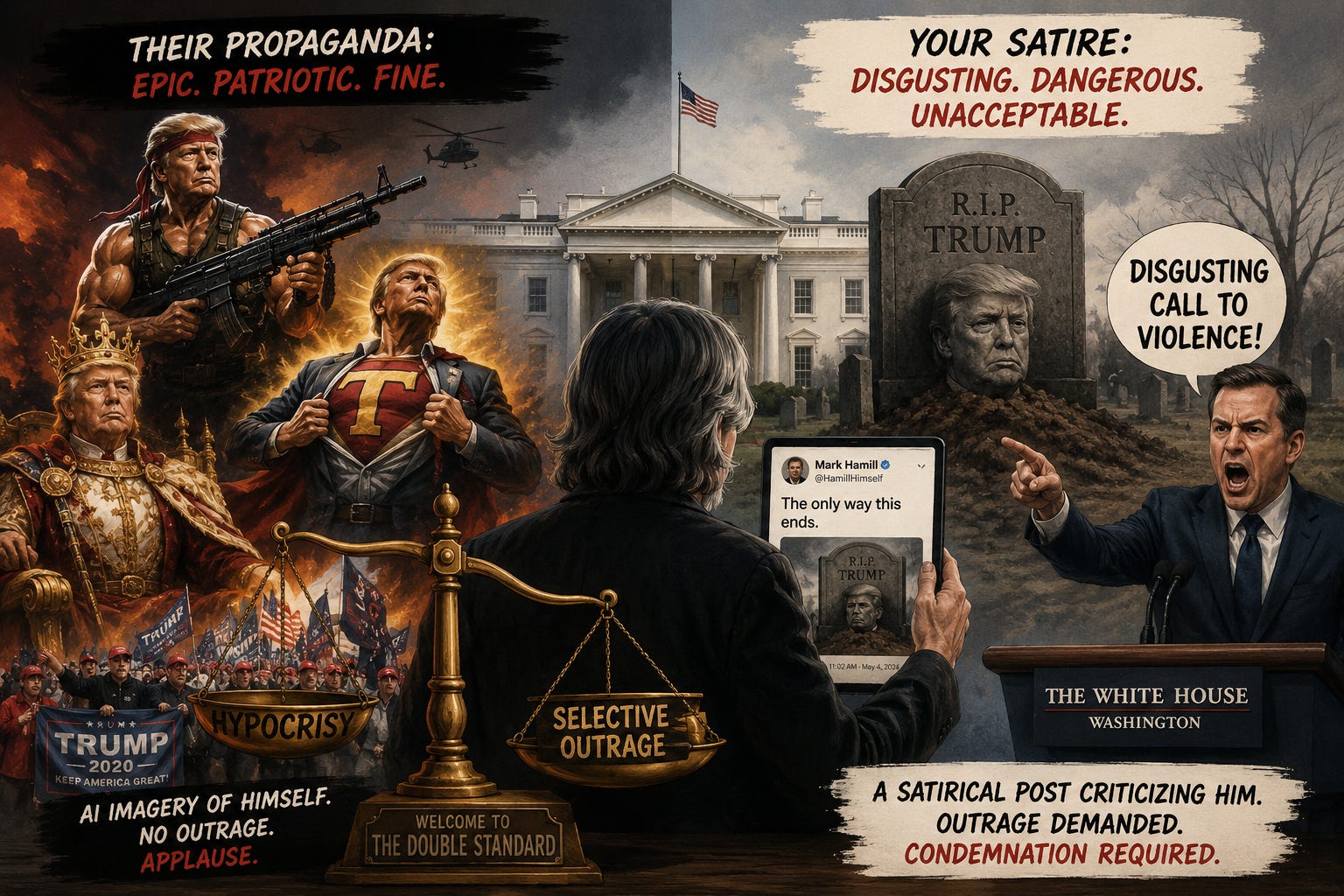
The modern American right has perfected a political strategy that operates less like governance and more like a permanent outrage refinery. Every controversy becomes raw material. Every cultural event becomes a loyalty test. Every opponent must be forced into ritual denunciation while the movement exempts itself from the standards it aggressively imposes on everyone else.
The latest example arrived wrapped in AI-generated imagery, celebrity politics, and the predictable performance of moral panic.
Help fuel the work. Independent analysis doesn’t fund itself:
☕ Buy us a coffee
Actor Mark Hamill — forever culturally fused with Luke Skywalker — posted an AI-generated image depicting Donald Trump in a grave. According to Hamill, the image was intended as political satire, symbolizing Trump’s eventual political and historical downfall rather than a literal call for violence. After backlash, Hamill removed the image and replaced it with a toned-down version while clarifying that he wanted Trump to live long enough to face legal accountability, electoral defeat, and historical disgrace.
That should have been the end of it.
Instead, the White House transformed the incident into another chapter in America’s endless partisan theater. Officials publicly demanded that former President Barack Obama condemn Hamill because Obama had recently appeared in a Star Wars Day promotional video alongside him.
The mechanism is familiar by now.
Find provocative content.
Demand condemnation.
Treat silence as endorsement.
Manufacture outrage.
Repeat.
It is one of the defining rhetorical tactics of modern authoritarian politics: asymmetric moral enforcement.
The Standards Only Apply One Way
The central absurdity of this controversy is impossible to miss.
Donald Trump built his political brand on escalation.
This is a man who encouraged crowds to rough up protesters at rallies.
This is a man who joked about political violence.
This is a man who spent years referring to political opponents as enemies, traitors, vermin, criminals, and threats to the nation.
This is a man whose rhetoric contributed directly to the climate that culminated in the January 6 attack on the Capitol.
And yet the same political ecosystem now presents itself as horrified guardians of civic decency because an actor posted a tasteless AI image.
The hypocrisy becomes even more grotesque when examining Trump’s own use of AI-generated imagery.
For years now, Trump and his online orbit have flooded social media with artificially generated fantasy propaganda depicting him as:
a hyper-muscular action hero,
a divinely ordained savior,
a king,
a warrior,
a messianic figure,
a conqueror,
or a persecuted martyr.
Images portraying Trump as a Rambo-style commando circulate constantly.
Images portraying Trump glowing like a religious icon circulate constantly.
Images portraying Trump physically overpowering political enemies circulate constantly.
The White House does not condemn those.
They do not call emergency press briefings over those.
They do not demand that Republican politicians publicly denounce those.
Because those images serve the mythology.
That is the actual dividing line.
The issue is not whether AI-generated political imagery is inflammatory.
The issue is whether the imagery reinforces or threatens the movement’s narrative.
AI Has Become the New Political Myth Machine
One of the most dangerous developments in modern politics is how artificial intelligence has collapsed the barrier between amateur propaganda and professional propaganda.
A decade ago, creating persuasive political imagery required technical skill.
Today, anyone with a prompt box can mass-produce emotionally manipulative visuals in seconds.
This matters because politics increasingly operates through emotional reflex instead of factual processing.
People do not carefully investigate context before reacting.
They react instantly.
Then they rationalize afterward.
AI imagery supercharges this phenomenon.
A crude Photoshop once looked crude.
An AI-generated image can look cinematic, emotionally immediate, and psychologically persuasive even when entirely synthetic.
The modern information ecosystem rewards speed over accuracy and emotional impact over nuance.
That makes AI-generated political imagery uniquely effective as a propaganda weapon.
And both sides of the political spectrum use it.
But there is a difference between using AI for satire and using AI to construct a personality cult.
The contemporary MAGA movement increasingly resembles the latter.
The Return of the Strongman Aesthetic
Authoritarian movements throughout history have always relied on visual mythology.
The leader must appear:
stronger than ordinary people,
wiser than ordinary people,
more masculine than ordinary people,
more patriotic than ordinary people,
and somehow fused with the destiny of the nation itself.
This is not new.
The Soviet Union did it.
Fascist Italy did it.
Nazi Germany did it.
North Korea perfected it.
Modern Russia does it.
The medium changes.
The psychological mechanism does not.
The leader becomes mythologized into something beyond criticism.
Criticism of the leader becomes criticism of the nation.
Criticism of the movement becomes betrayal.
Trump’s endless flood of AI-generated hero imagery fits perfectly into this historical tradition.
The hyper-muscular Trump images are not simply memes.
They are ideological branding.
The “Trump as savior” imagery is not merely internet humor.
It is the construction of emotional legitimacy.
The movement constantly portrays Trump as simultaneously:
omnipotent,
persecuted,
heroic,
victimized,
and indispensable.
This contradiction is not accidental.
It is politically useful.
The strongman must always appear invincible while also appearing under siege.
That duality fuels loyalty.
A movement built around grievance requires permanent persecution narratives.
A movement built around authoritarianism requires permanent displays of strength.
AI imagery now supplies both on demand.
January 6 Changed Nothing
One of the most infuriating aspects of this manufactured outrage cycle is that it exists after January 6.
The United States literally witnessed a mob attack the Capitol while attempting to overturn an election.
People died.
Police officers were assaulted.
Lawmakers fled for safety.
The democratic transfer of power came under direct attack.
And yet the political movement associated with that event now attempts to present itself as uniquely concerned about dangerous rhetoric.
This is where the discussion stops being merely hypocritical and starts becoming openly cynical.
Because the issue was never violence.
The issue was ownership.
Violence, intimidation, and extremist rhetoric are tolerated — even celebrated — when deployed in service of the movement.
When directed against the movement, however, even satire becomes treated as existential extremism.
That asymmetry defines modern right-wing political communication.
January 6 demonstrated that large portions of the movement had already abandoned democratic norms in practice.
The years since have demonstrated they also intend to monopolize the language of victimhood.
They want the power to intimidate opponents while retaining the rhetorical privilege of claiming persecution whenever resistance emerges.
Obama as a Propaganda Target
The attempt to drag Barack Obama into the controversy is especially revealing.
Obama did not create the image.
Obama did not endorse the image.
Obama merely appeared alongside Hamill in an unrelated promotional event.
But in the logic of outrage politics, proximity itself becomes guilt.
This tactic serves several purposes simultaneously.
First, it extends the lifespan of the controversy.
Second, it forces opponents into defensive posture.
Third, it creates a public loyalty ritual.
Fourth, it frames silence as moral cowardice.
The actual goal is not accountability.
The goal is domination of the narrative cycle.
Modern outrage politics functions less like debate and more like hostage-taking.
You are not allowed to simply disagree.
You must perform public submission to the framing itself.
And because media ecosystems thrive on conflict amplification, these cycles become self-sustaining.
Every denunciation produces new headlines.
Every headline produces new outrage.
Every outrage cycle feeds fundraising, engagement, and tribal cohesion.
It is political perpetual motion.
The Collapse of Information Credibility
Another underappreciated aspect of this story is the quality of the sourcing.
The article itself appears to be AI-curated aggregation stitched together from low-credibility outlets and engagement farms.
That is increasingly common.
Modern political media is becoming flooded with AI-assembled outrage content where:
sourcing is murky,
quotes are selectively framed,
context is fragmented,
and emotional impact matters more than verification.
This is not merely a technological problem.
It is an economic one.
Outrage generates clicks.
Clicks generate advertising revenue.
Algorithmic systems reward emotional engagement.
Therefore media systems increasingly optimize for emotional escalation.
Truth becomes secondary.
The internet is slowly evolving into an environment where synthetic media, AI-generated imagery, and AI-curated narratives blur together into a permanent haze of manipulated emotional stimulus.
And authoritarian politics thrives in informational chaos.
When objective credibility collapses, tribal identity becomes the replacement.
People stop asking whether information is true.
They ask whether it supports their side.
That transformation is poison for democratic systems.
Satire, Stupidity, and Selective Enforcement
To be clear: political imagery involving graves, executions, or implied death is reckless in the current environment.
The United States is politically unstable.
The country has already experienced assassination attempts, political violence, and growing radicalization.
Hamill likely underestimated how quickly the imagery itself would eclipse whatever satirical intent accompanied it.
That was politically careless.
But carelessness is not the same thing as incitement.
And the people screaming loudest about the image belong to a political movement that normalized violent rhetoric for nearly a decade.
That is why the outrage rings hollow.
The same ecosystem that shrugged at:
“Hang Mike Pence,”
violent rally rhetoric,
threats against judges,
harassment of election workers,
fantasies about military crackdowns,
and endless civil war memes,
now suddenly demands national soul-searching because Mark Hamill posted edgy satire.
The selective enforcement is so blatant that it becomes impossible to interpret as sincere.
The Real Purpose of the Outrage
The White House reaction was never truly about protecting civility.
It was about reinforcing a hierarchy.
Their message is simple:
Our propaganda is patriotism.
Your satire is extremism.
Our rhetoric is strength.
Your rhetoric is dangerous.
Our fantasies are harmless.
Your imagery is violence.
That asymmetry is not accidental.
It is central to modern authoritarian political communication.
Because authoritarian movements do not seek neutral standards.
They seek control over who is allowed to speak aggressively.
The goal is not universal restraint.
The goal is monopoly power over escalation.
And once you recognize that pattern, controversies like this stop looking spontaneous.
They start looking engineered.
Not because the outrage is fake.
The outrage is very real.
But because outrage itself has become the product.
America’s political system is no longer merely polarized.
It is monetized emotional warfare conducted through algorithms, tribal loyalty, and endless cycles of selective moral panic.
AI did not create this environment.
It merely accelerated it.
And the people pretending to defend civility while cultivating cult imagery around a man who helped incite an attack on the Capitol are among the least credible messengers imaginable.